
Our Flagship
Our Flagship
The Hercules Project
Positioned to Operate
Overview
The Hercules Project is home to America’s newest copper porphyry belt and the Leviathan discovery, one of the largest new porphyry copper discoveries in the United States. Located near Cambridge, Idaho, the Project is strategically positioned in a premier North American mining jurisdiction with exceptional scale, infrastructure, and development potential. Hercules Metals holds a 100% ownership interest in the 26,000 acre Hercules Project, as well as an option to acquire a 100% interest in more than 74,000 additional acres of mineral rights, with underlying NSR royalties that can be bought down to between 0.25% and 1%.
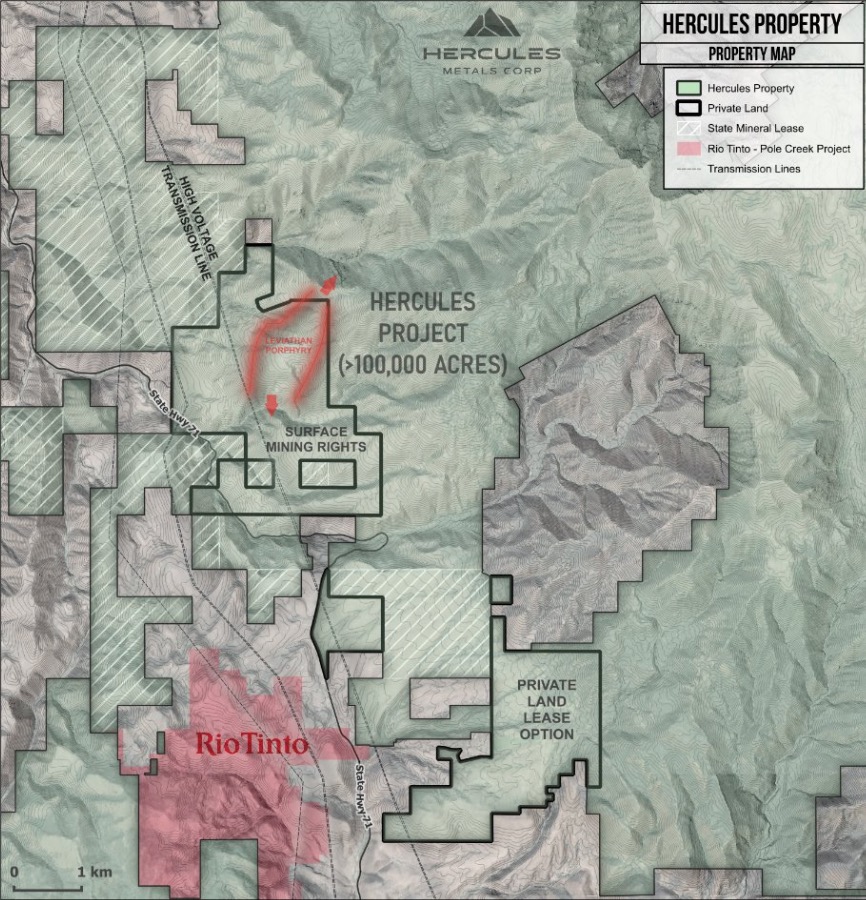
The Project benefits from outstanding infrastructure advantages that support efficient exploration and future development. Approximately 3,300 acres of surface rights, together with a private land lease option, provide a strong foundation for long-term operations.
Location
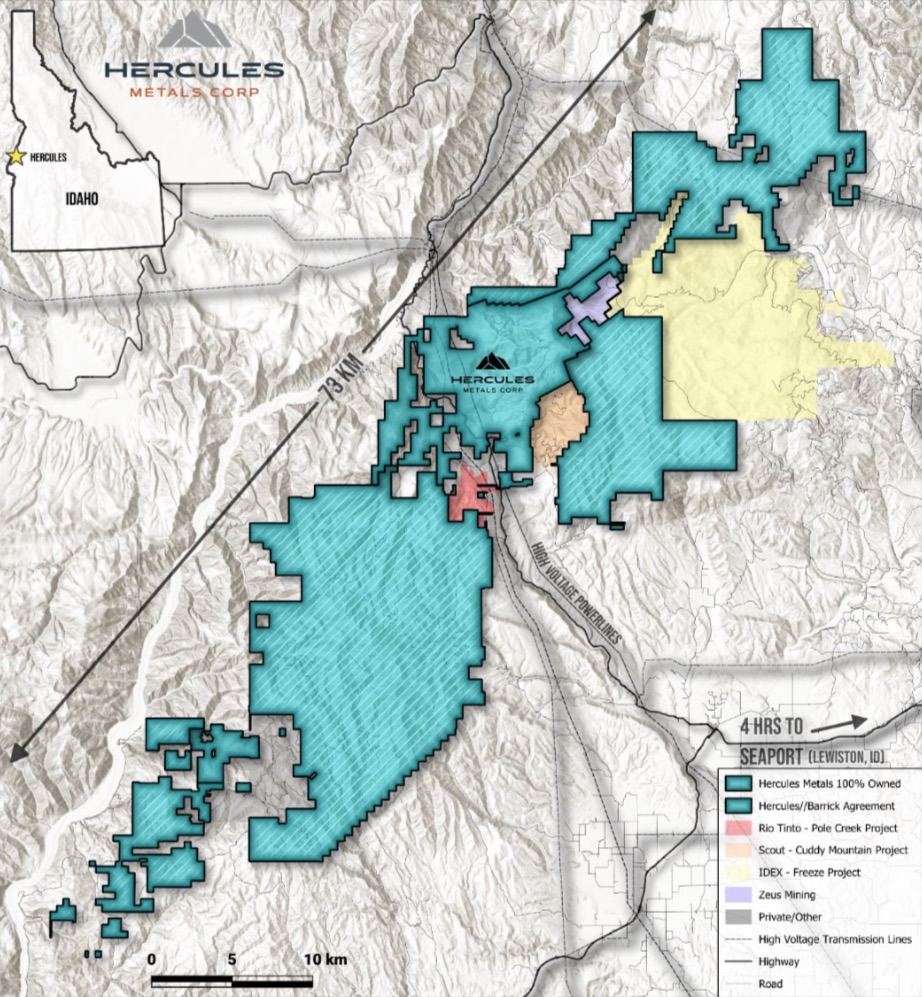
Located just two hours from Boise, with a state highway less than 1 km from the deposit and road access to every drill site, Hercules offers year-round accessibility. The Property is also traversed by three 260 kV transmission lines delivering approximately 1,200 MW of clean electricity, while Idaho’s power costs—among the lowest in the United States at approximately US$0.10/kWh—further enhance the Project’s long-term economic potential.
Idaho combines world-class geology with a mining-friendly regulatory framework, making it one of the most attractive jurisdictions in the United States for copper exploration and development.
The Idaho Advantage
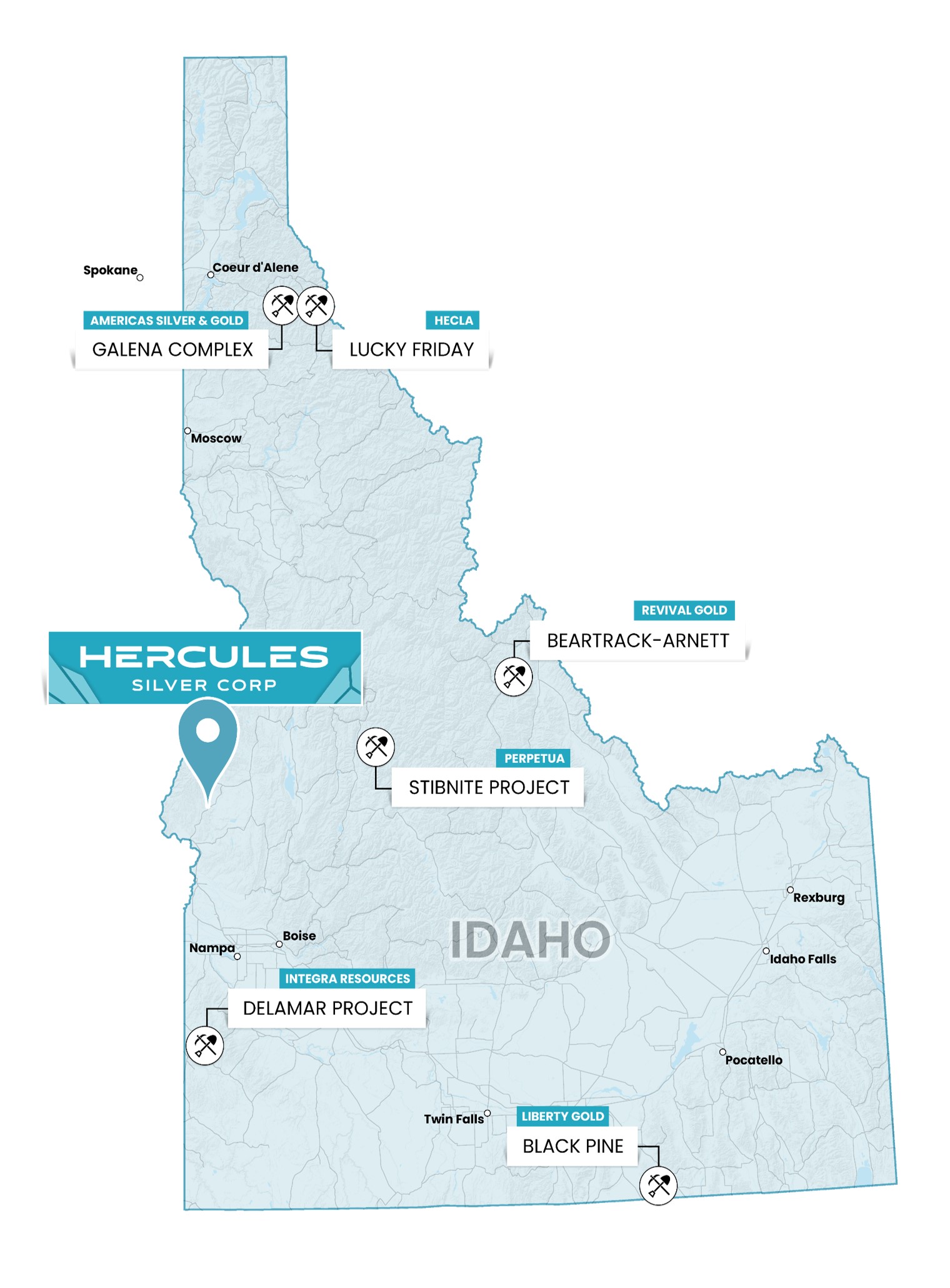
Idaho is consistently recognized as one of North America’s premier mining jurisdictions, supported by exceptional mineral potential, stable regulation, and a pro-development environment.
Low Geopolitical Risk
Pro-resource state with low geopolitical risk. Streamlined state permitting.
Trump Administration Overhauled Federal Permitting
New federal permitting rules significantly fast track exploration and mine permitting in the United States, particular for copper projects.
Surface Mining Rights over Discovery
Drill permitting not required on Leviathan copper discovery due to the Company having deeded surface mining rights to land.
Strong support from Local Community
Company hosts annual town hall meetings, provides financial support to local organizations, and hires locally to maintain good standing in the community.
What Changed?
Modern Technology Generates Large Porphyry Copper Discovery
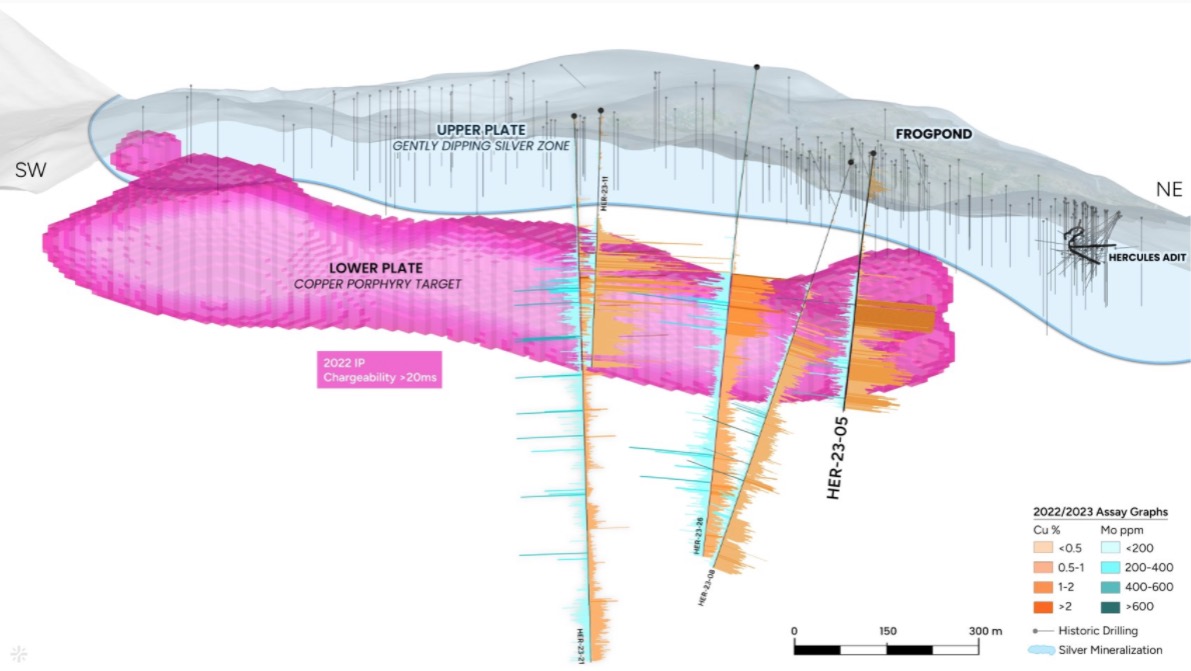
While previous operators completed 308 drill holes targeting a near-surface epithermal silver system, the true scale of the Project remained undiscovered historically. By combining modern geophysics with a new geological interpretation, Hercules Metals made the Leviathan discovery in 2023, establishing one of the largest new porphyry copper discoveries in the United States in recent decades. This proven exploration strategy is now being expanded across the Company’s 100,000+ acre land package in search of additional porphyry centers.
What changed?
Modern Technology Generates Large Porphyry Copper Discovery
While previous operators completed 308 drill holes targeting a near-surface epithermal silver system, the true scale of the Project remained undiscovered. By combining modern geophysics with a new geological interpretation, Hercules Metals made the Leviathan discovery in 2022, establishing one of the largest new porphyry copper discoveries in the United States in recent decades. This proven exploration strategy is now being expanded across the Company’s 100,000+ acre land package in search of additional porphyry centers.
A Rare New Porphyry Copper Discovery in the U.S.A.
2023 Leviathan Discovery
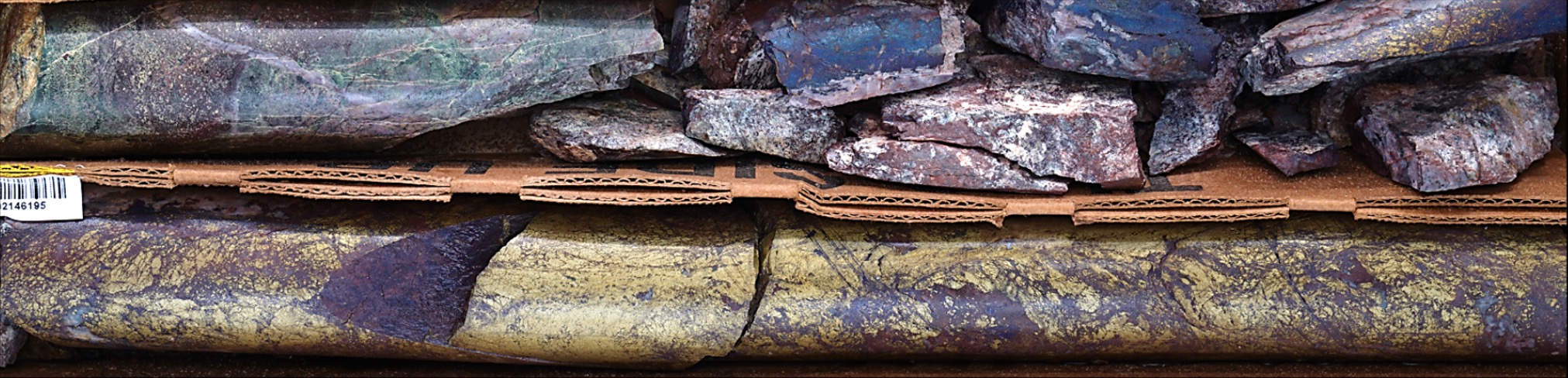
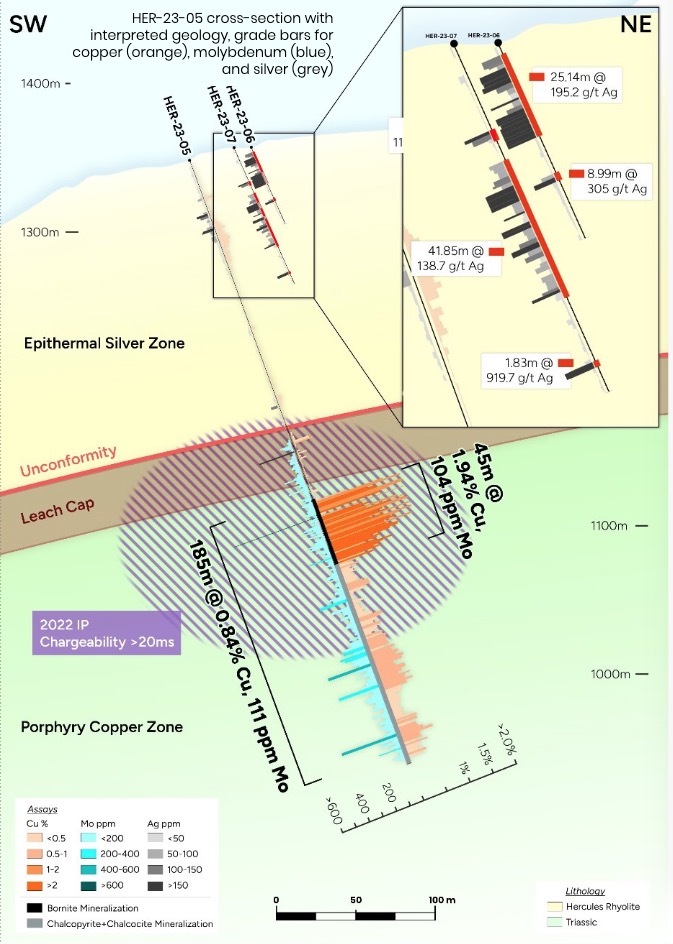
In 2023, Hercules Metals’ first deep drill hole beneath the near-surface silver system led to the discovery of a porphyry copper system with exceptional grades, marking a breakthrough for the Project. The initial intercept returned 0.84% copper, 111 ppm molybdenum, and 2.6 g/t silver over 185 metres, including the first 45 metres grading 1.94% copper. The discovery was made beneath a younger epithermal silver system, where overlying drill holes had previously intersected 139 g/t silver over 42 metres, demonstrating the presence of two distinct, stacked mineralizing events and highlighting the untapped potential of the district.
Control of the Largest New Copper Belt in the United States
The 73 km Olympus Copper Belt
The Olympus Belt spans approximately 73 kilometres, making it one of the most significant new copper districts identified in the United States. Through its partnership with Barrick, Hercules Metals has consolidated control of more than 100,000 acres across America’s newest porphyry copper belt, creating a district-scale land position with exceptional long-term exploration potential.
Project Olympus represents a generational opportunity for shareholders and potential acquirors to benefit from decades of additional brownfields exploration and discovery. Hercules is advancing a belt-scale exploration strategy across the district, systematically identifying new porphyry targets for potential partner-funded drilling and future growth.
Highlights
Ownership
The Project is located mostly on Idaho state land with grandfathered exploration, mining and milling rights. The Company’s U.S. subsidiary, Anglo-Bomarc, U.S., Inc. was deeded the right to use the surface for mining over the discovery area, originating from a 1965 option agreement. The Project is subject to a 2% NSR, half of which is buyable for CAD $1M.
Geology
Series of stacked thrust sheets emplaced rhyolite-hosted silver (+/-lead-zinc) mineralization directly above a large blind porphyry copper system.
Discovery drilling in 2023 located large zones of porphyry style alteration at depth, which is inferred to have a similar strike length to the overlying silver mineralization; approximately 5.5 kilometers.
Extensive Exploration History
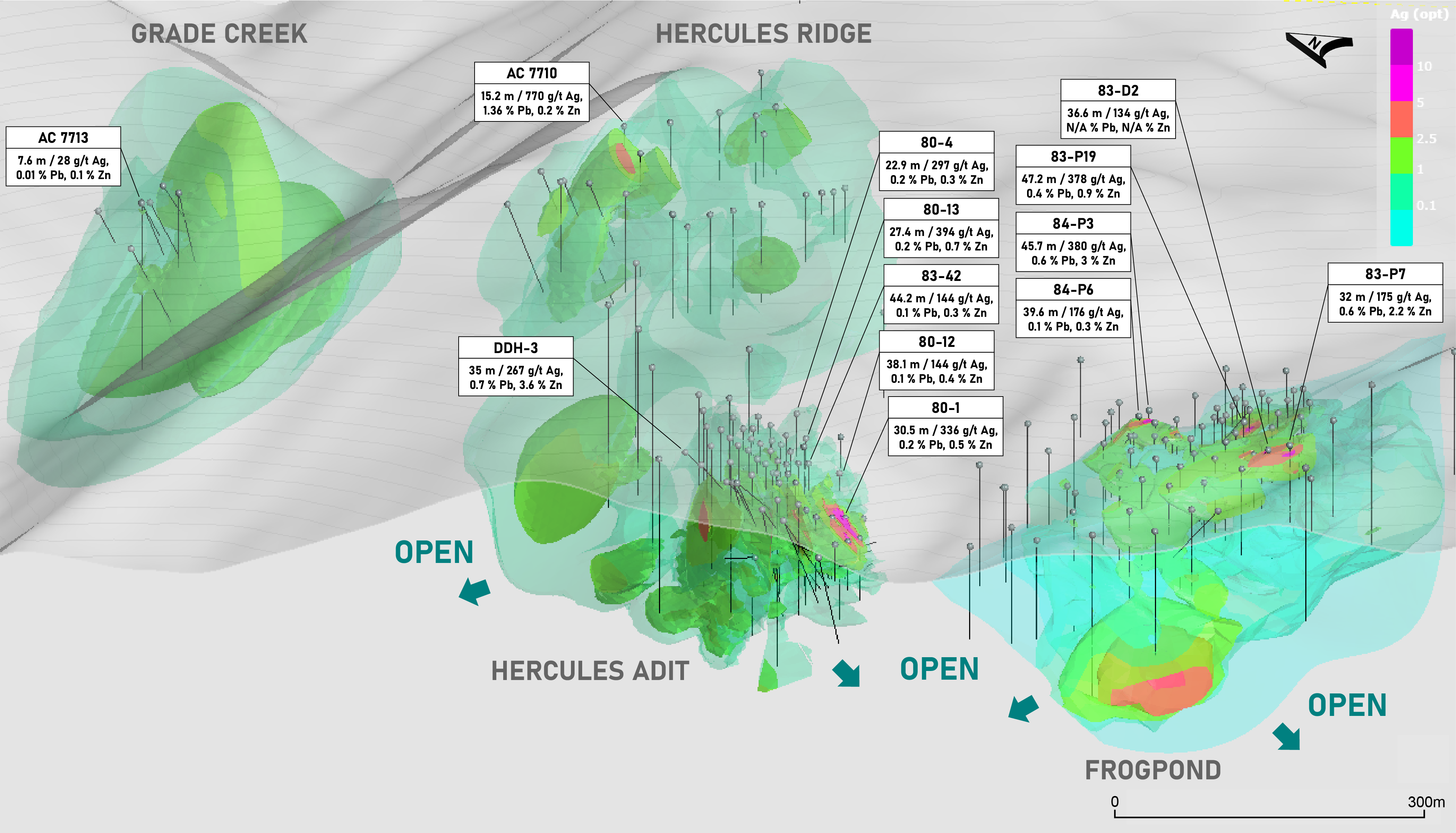
28,000 meters of historical drilling (>300 holes from 1965-1988), defined several continuous zones of silver mineralization with average depths of less than 90 meters.
Prior to Hercules Metals, the Project had never seen a modern, systematic exploration program.
Methodical Exploration
Since 2021: 2 phases of soil sampling, rock chip sampling, hyperspectral analysis, geological mapping, drone magnetics, 2 phases of IP geophysics, and 2 phases of drilling have been completed.
Since 2022: ~7,000 meters of drilling have been completed in 35 drill holes across the Property.
Current
Exploration
The November 2022 Phase I drill program was designed to test and verify historical drilling assays as well as gain the geological and geotechnical information needed to support a Phase II drilling campaign in early spring of 2023.
The program consisted of infill and step-out holes at the Frogpond and Hercules Adit Zones with additional step-out holes to test open zones with little to no prior drilling.
A total of 1,995 feet in 9 drill holes was completed, with several holes bottoming in mineralization, and high-priority areas were tested within the Frogpond and Hercules Adit Zones for potential inclusion in future resource estimates. (See Feb 28 NR).
Highlights of the program include:
- Strong grade over multiple significant intervals, including drill hole HER-22-01, the first hole of the program, which intercepted 38 meters of 353 g/t Ag, 0.64% Pb, 2.28% Zn and 0.16% Cu (487 g/t AgEq), beginning at a shallow depth of 26 m depth in first drill hole, HER-22-01.
- HER-22-01 included a higher-grade intercept of 4.57 m grading 791 g/t Ag, 1.25% Pb, 4.06% Zn and 0.18% Cu (1,021 g/t AgEq) starting at 29 m.
- HER-22-07 intersected 44.2 m grading 224 g/t Ag, 0.32% Pb, 0.38% Zn and 0.09% Cu (258 g/t AgEq) starting at 1.5 m.
- Drilling grades significantly exceed grades sampled at surface, supporting the concept of potential supergene enrichment of mineralization below surface.
- Confirmed the presence of a high-grade shoot (the P-19 Shoot) at the east end of the Frogpond Zone; open at depth to the east.
- Confirmed the presence of shallow, high-grade mineralization at Frogpond and Hercules Adit Zones, with additional follow-up planned for Phase II.
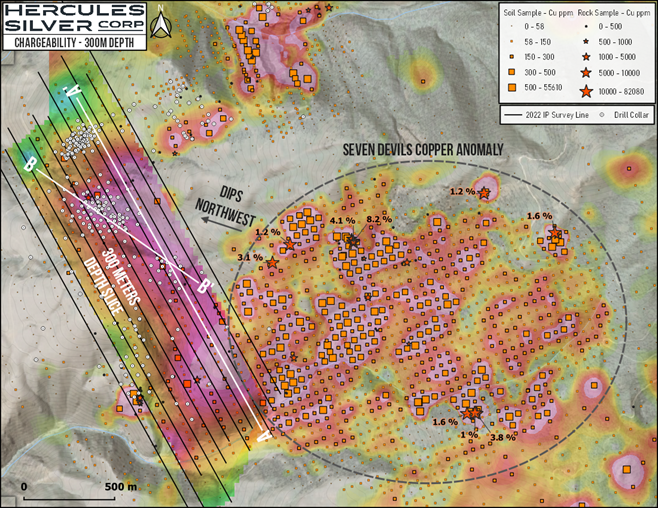
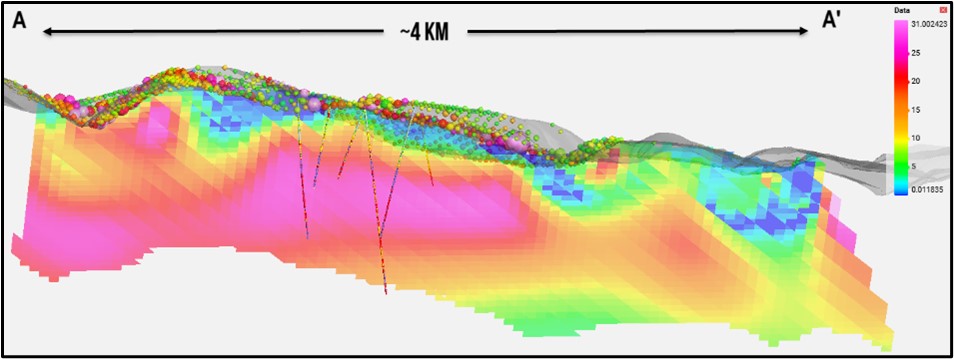
The 2022 3D IP survey over the Hercules Adit, Frogpond and Belmont Zones, identified a large untested chargeability anomaly at depth. The results demonstrated the excellent exploration potential at Hercules and contributed to 2023 drilling.
- Strong chargeability values (>25ms), below historical drilling, and over a continuous strike length of 1.8 kilometers
- Anomaly is coincident with the untested base of the Hercules Rhyolite where surface mapping indicates the strongest silver mineralization to occur (See Oct 18 NR)
- Lower portion of anomaly lies down dip of the copper mineralization hosted within the underlying Seven Devils volcanics
- Anomaly remains open up-dip to the southeast
The summer 2023 Phase II drill program consisted of step-out holes designed to test for extensions of historical mineralization, verify previous historical drilling and test a series of new targets generated by greenfields exploration.
The 6,000 m program focused on the following targets:
- Hercules Adit and Frogpond Zones: Step-out holes aiming to extend mineralization, as well as infill and further verify historical drilling results.
- Hercules Rhyolite: Robust silver targets identified through surface mapping, geophysics and geochemistry, including at the Hinge, Haystack and Belmont Zones.
- New porphyry copper-silver (+/- gold) target: Interpreted as the center of a large zoned system and feeder for the surrounding silver (+/-lead-zinc) hosted in the Hercules Rhyolite.
- Large-scale untested chargeability anomaly at depth, potentially representing a large body of strong sulfide mineralization.
Five deep drill holes encountered strong phyllic alteration, which is typical of the margins of a porphyry system, over approximately 450m x 500m, called the Leviathan Porphyry. HER-23-05, the first hole to test a large-scale (>1.8km) blind chargeability anomaly, intersected 185.29m of 0.84% Cu and 111 ppm Mo from 246m to 431.2m, including 45.33m of 1.94% Cu.
Additional step-out holes drilled at various orientations to the southeast of HER-23-05, where chargeability data was currently available, intersected similar alteration, veining and copper mineralization over variable lengths. Many directions remain to be tested, and the potassic center, which often carries the highest grades within porphyry systems, remains to be found.
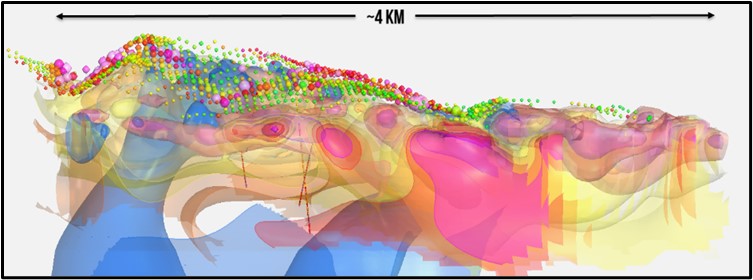
The 2023 property-wide deep-seeking IP survey was designed to explore the new Leviathan Porphyry at depth. The new survey expanded on the initial chargeability anomaly first tested last year and revealed trends that are comparable with known porphyry copper systems.
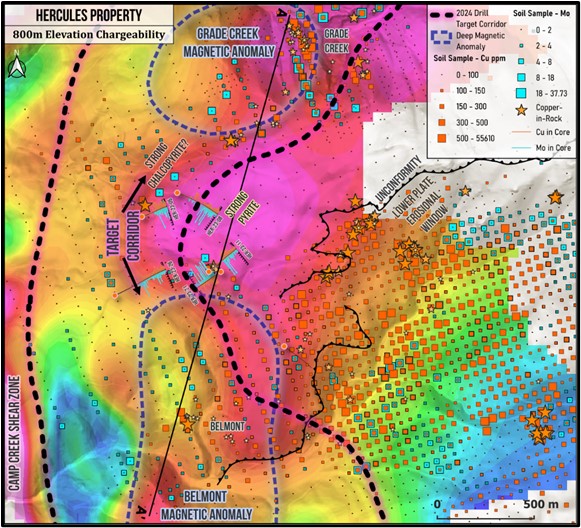
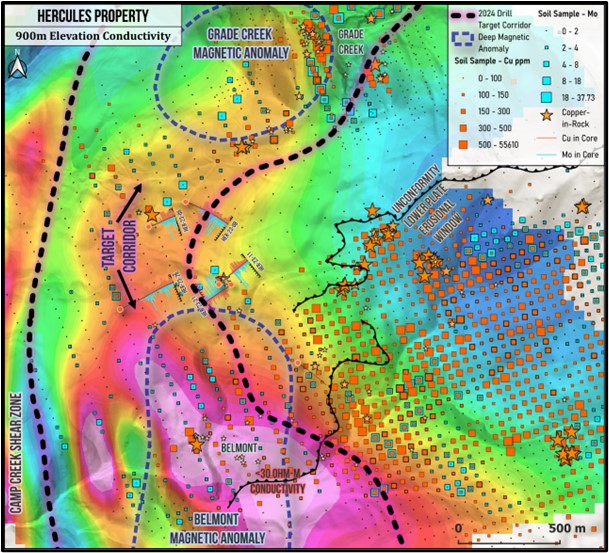
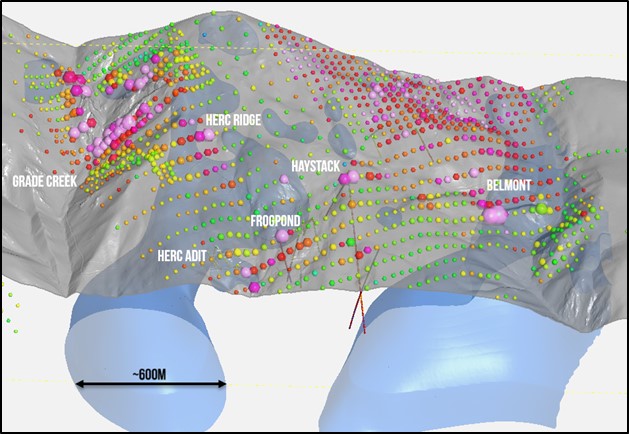
The deep-seeking 3D IP, direct current resistivity and drone magnetic geophysics over the area to be drill tested in 2024, revealed multiple prospective targets, coincident with the direction of increasing copper porphyry grades seen in the initial 2023 deep discovery holes drilled at the Leviathan Porphyry.
- Conductivity anomaly below historical mining at the Belmont Zone
- Kilometers of prospective chargeability from Belmont to Grade Creek
- Moderate chargeability anomaly near surface at the Big Cut Skarn provides an additional satellite drill target
- 3D magnetic inversion reveals magnetic highs potentially associated with a potassic core.
- Soil sampling, mapping, and prospecting planned to cover extensions of newly identified geophysical targets
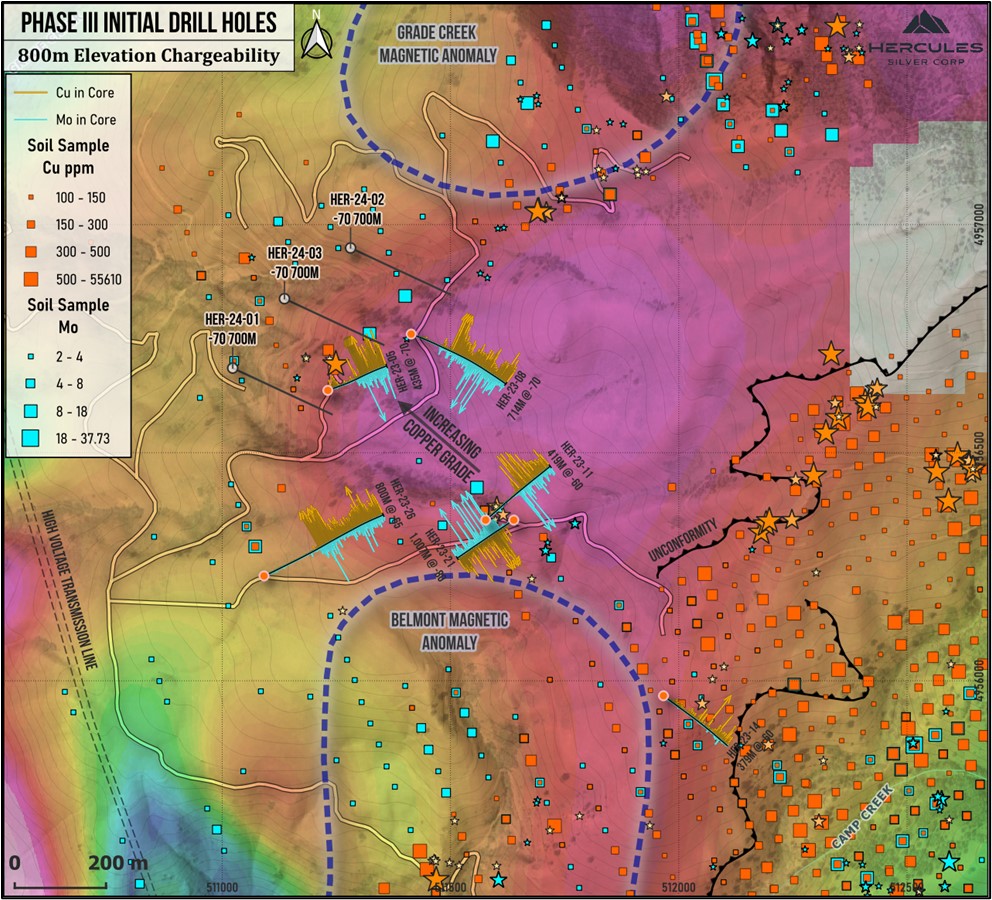
The summer 2024 Phase III program encompasses 20,000m of drilling which will consist of drilling 200m centers along NW-SE fences, starting west of the 2023 discovery area, and testing new magnetic anomalies and conductivity and chargeability anomalies identified by the 2023 deep-seeking 3D IP survey.
- The phase III drill program will focus on multiple targets, including:
- Drilling on 200m centers along NW-SE fences, starting with three holes to the west, northwest and north from HER-23-05, which had the best copper intercept in 2023 of 185.29m of 0.84% Cu and 111 ppm Mo from 246m to 431.2m, including 45.33m of 1.94% Cu in an upper enrichment blanket.
- A conductivity anomaly at the Belmont Zone identified by the 2023 IP survey. Prospecting of historical waste dumps at Belmont recently uncovered strong chalcocite mineralization, potentially sourced from an underlying enrichment blanket.
- Two magnetic high anomalies below the Belmont and Grade Creek Zones, potentially representative of magnetite alteration, commonly associated with a central potassic zone.
- Near surface chargeability anomaly at the Big Cut Skarn, situated at the edge of the IP survey.
Technical
Maps & Figures
Historical
Drilling
Paper drill logs from the 1960’s-1980’s were recovered and digitized into a modern database. Assays include:
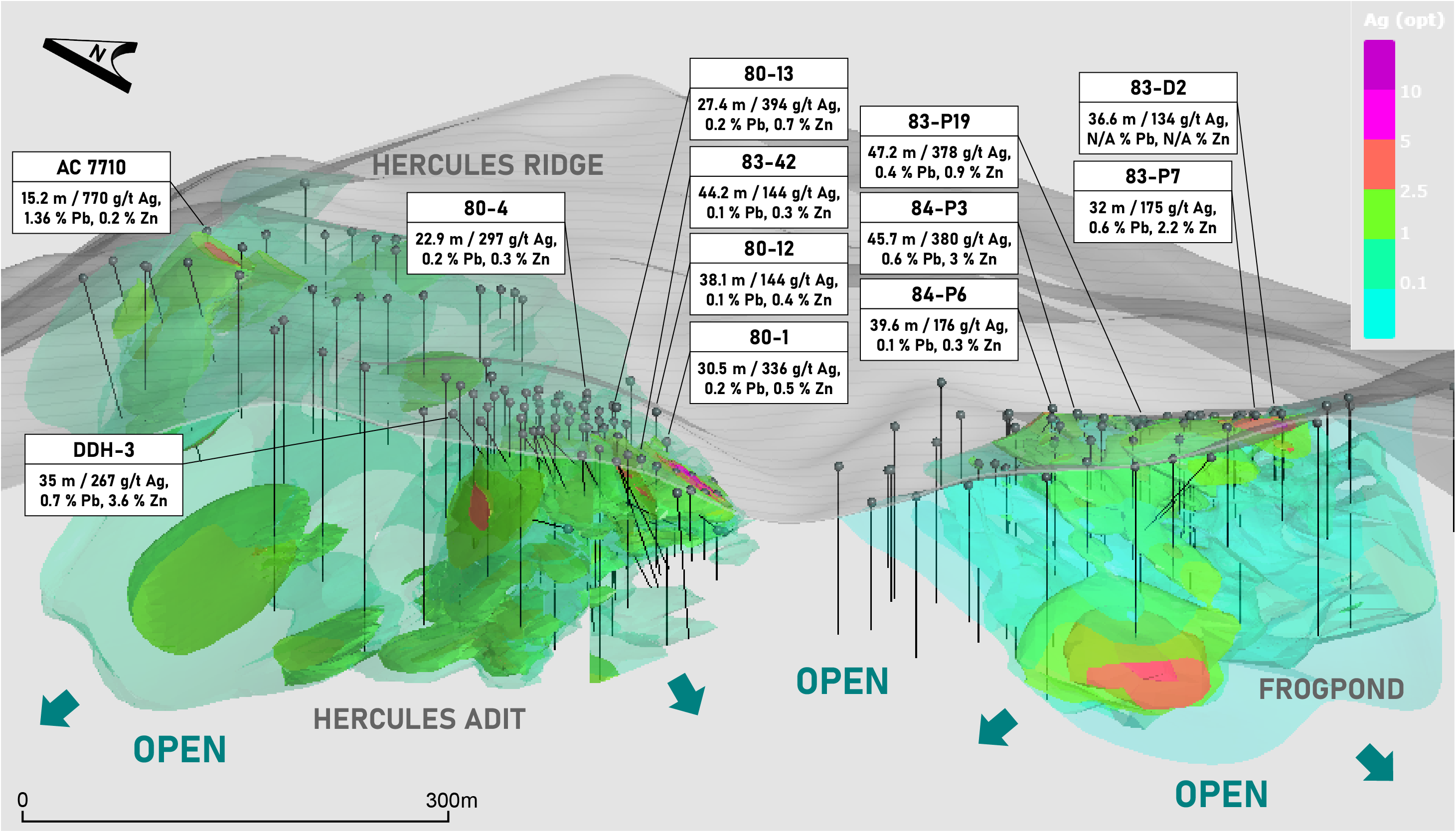
Hole ID | Year | From (m) | To (m) | Interval (m) | Ag (g/t) | Pb (%) | Zn (%) |
| 80-1 | 1980 | 73.15 | 103.63 | 30.48 | 335.6 | 0.17 | 0.54 |
| including | 1980 | 82.3 | 91.44 | 9.14 | 828.2 | 0.24 | 0.8 |
| including | 1980 | 96.01 | 99.06 | 3.05 | 317.8 | 0.04 | 0.22 |
| 80-12 | 1980 | 7.62 | 22.86 | 15.24 | 56 | No Assay | No Assay |
| AND | 1980 | 36.58 | 74.68 | 38.1 | 144.3 | 0.13 | 0.37 |
| including | 1980 | 50.29 | 53.34 | 3.05 | 485 | No Assay | No Assay |
| AND | 1980 | 82.3 | 97.54 | 15.24 | 129 | 0.02 | 0.07 |
| 80-13 | 1980 | 114.3 | 141.73 | 27.43 | 394.3 | 0.21 | 0.7 |
| including | 1980 | 115.82 | 126.49 | 10.67 | 904.3 | 0.32 | 1.31 |
| 80-04 | 1980 | 85.34 | 108.2 | 22.86 | 297.4 | 0.22 | 0.26 |
| 83-42 | 1983 | 1.52 | 45.72 | 44.2 | 143.9 | 0.13 | 0.26 |
| including | 1983 | 12.19 | 15.24 | 3.05 | 807.7 | 0.25 | 0.21 |
| 83-P19 | 1983 | 15.24 | 62.48 | 47.24 | 377.5 | 0.39 | 0.91 |
| Including | 1983 | 24.38 | 32 | 7.62 | 606.2 | 0.49 | 1.64 |
| Including | 1983 | 35.05 | 44.2 | 9.15 | 1,166.40 | 1.05 | 1.82 |
| 83-P7 | 1983 | 42.67 | 74.68 | 32.01 | 174.6 | 0.56 | 2.21 |
| 84-P3 | 1984 | 25.91 | 71.63 | 45.72 | 380.3 | 0.61 | 3 |
| Including | 1984 | 27.43 | 33.53 | 6.1 | 998.9 | 1.18 | 7.53 |
| 84-P6 | 1984 | 4.57 | 44.2 | 39.63 | 175.9 | 0.12 | 0.32 |
| AC 7710 | 1977 | 44.2 | 59.44 | 15.24 | 770 | 1.36 | 0.2 |
| Including | 1977 | 48.77 | 56.39 | 7.62 | 1,377.70 | 2.62 | 0.3 |
| AND | 1977 | 126.49 | 132.59 | 6.1 | 146.2 | 0.05 | 0.1 |
| DDH-3 | 1965 | 33.53 | 35.05 | 1.52 | 289.3 | 0.1 | No Assay |
| AND | 1965 | 44.2 | 68.58 | 24.38 | 122.9 | No Assay | No Assay |
| AND | 1965 | 82.3 | 117.35 | 35.05 | 266.7 | 0.69 | 3.63 |
| Including | 1965 | 92.96 | 99.06 | 6.1 | 718.5 | 0.48 | 1.63 |
| RC 771 | 1977 | 77.72 | 109.73 | 32.01 | 300.3 | 0.22 | 0.49 |
| including | 1977 | 97.54 | 106.68 | 9.14 | 750.1 | 0.34 | 0.4 |
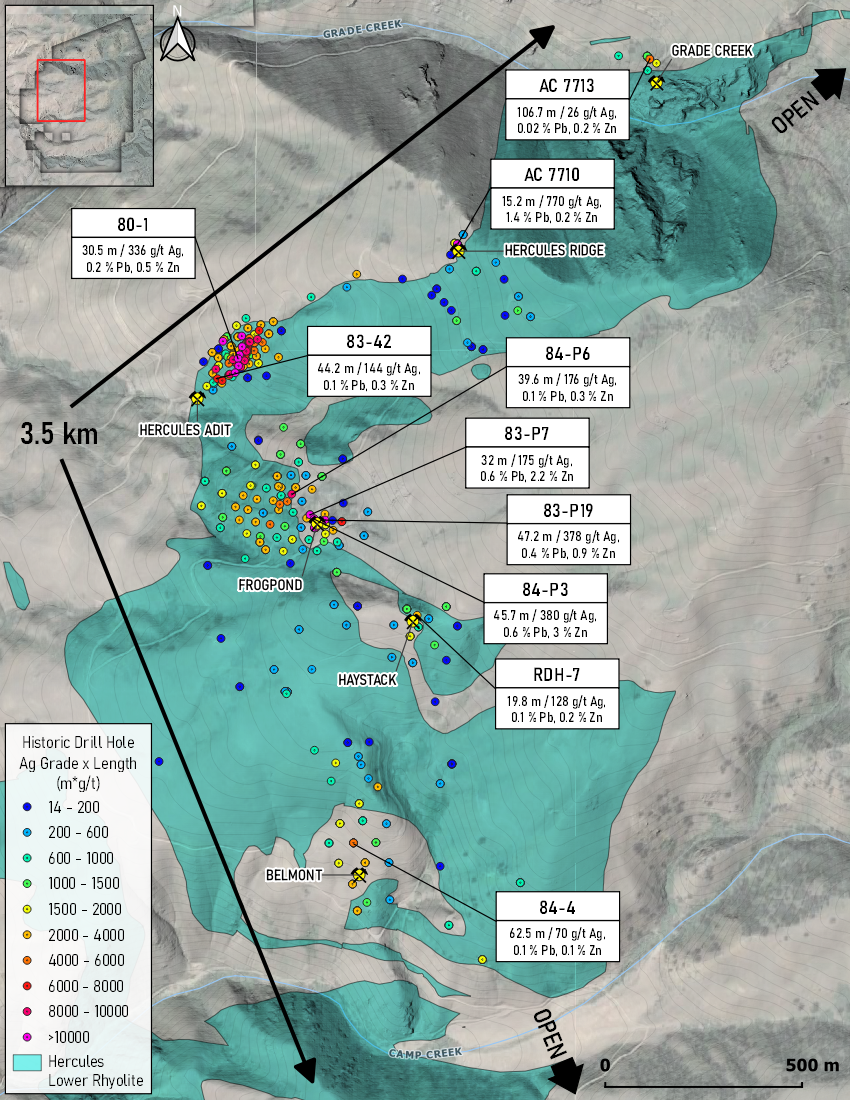
Above: Select historical intercepts from 1965-1988 demonstrate some of the better holes drilled
Historical
Timeline
1880
First production at the Belmont Zone
1920s
Production at the Hercules Adit
1965
First hole drilled at the Hercules Adit Zone which was mined in the early 1900’s for high-grade silver
Late 1970s - Early 1980s
Strong silver prices lead to aggressive drilling at the Fishpond and Hercules Adit Zones, defining two zones of continuous mineralization. Drilling along strike successfully discovered 4 other zones at the Belmont, Haystack, Hercules Ridge and Grade Creek
1983-1984
144 holes drilled in 1983-84, followed by a collapse in silver prices shortly thereafter, leaving the project orphaned throughout the bear market of the 90’s and early 2000’s
2021
Hercules Metals Corp. (formerly Bald Eagle Gold) acquires the Hercules Project
2022
New exploration completed, including digitizing the entire historical exploration database; Prepared robust 3D geological model in Leapfrog; Increased property size via direct staking of prospective ground; Collected over 2,500 soil samples, and identified, mapped and prospected a new porphyry copper style anomaly
2023
Property-wide chip and channel sampling of untested mineralized outcrops; Property-wide 3D IP geophysical survey; Detailed structural, stratigraphic and alteration mapping; Confirmation drilling of select historical drill holes; Metallurgical testing of both oxide and sulfide mineralization;; Step-out drilling on the Hercules Adit and Fishpond Zones; Exploration drilling of new targets and blind discovery of the Leviathan Porphyry target, which resulted in a strategic investment by Barrick Gold and 3D deep seeking IP revealing additional property wide targets
2024
Largest drill program to date with 20,000m underway to test discovery area and new magnetic anomalies and conductivity and chargeability anomalies identified by the 2023 deep-seeking 3D IP survey